
The History of Solitaire: From Patience to Klondike and Windows
Solitaire feels timeless, but it has a surprisingly short and colourful history. It began as a parlour pastime in 18th-century Europe, travelled to the Americas, picked up the name of a Canadian gold rush, became one of the most played computer games in the world, and found a new generation of players on their phones. Here is how a simple game for one turned into a worldwide habit.
Today solitaire lives in web browsers and on phones and tablets as much as on tables. Modern versions add things the original players could only dream of: unlimited undo, hints, timers, statistics, daily challenges and deals that are known to be winnable. The game itself has hardly changed: it is still the same seven columns, the same Ace-to-King foundations and the same satisfying moment when the last King goes home.
That is what FreeSolitaireHub.com is built for: classic Klondike, Draw 1 or Draw 3, free in your browser with no download. If you are new to the game, start with our guide on how to play solitaire, which covers the rules, the setup and some beginner strategy, then try a deal or the daily challenge.
-

Nobody knows exactly who invented solitaire, but the trail starts in northern Europe in the second half of the 1700s. The earliest known written description of the game appears in the 1783 edition of a German games book, Das neue Königliche L’Hombre-Spiel, where it is called Patience. Historians think the game is probably of German or Scandinavian origin.
The surprise in that first description is that it was not a game for one. Two players each laid out their own cards and took turns, and the winner was the first to finish. Over the following decades the idea of playing alone, purely as a personal challenge, took over, and that is the game we know today. The old name stuck: in Britain and much of the world, card games for one are still called patience, a fitting word for a game that rewards calm, careful thinking.
-
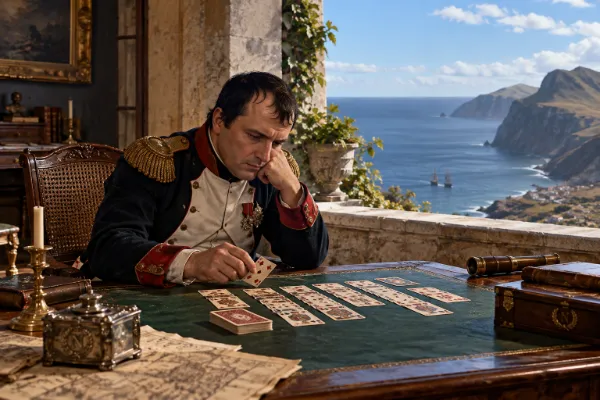
In the early 19th century patience became fashionable in France, and from there it spread to Britain and then to America. Many of the games played at the time took French names, and a number of them were named after Napoleon, such as Napoleon at St Helena and Napoleon’s Square.
That gave rise to a popular story that Napoleon passed his last years in exile on the island of St Helena (1815–1821) playing patience. It is a charming picture, but the evidence for it is thin: the detailed memoirs of his companions on St Helena say little or nothing about it, and patience games were already being described in Germany when Napoleon was still a teenager. The Napoleon names are most likely a later marketing flourish rather than proof that he played.
-
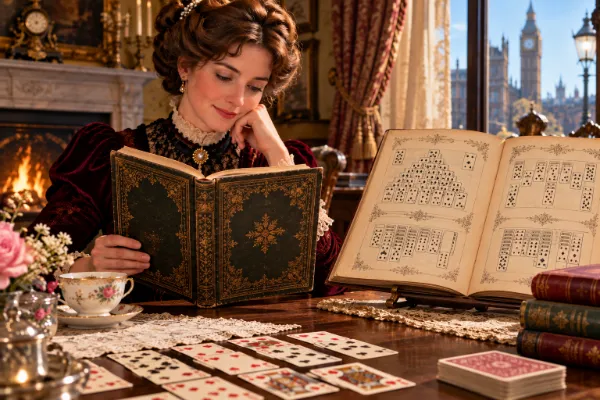
By the second half of the 19th century, patience was a favourite pastime in Victorian parlours, and publishers rushed to print collections of games. One of the best known is Illustrated Games of Patience by Lady Adelaide Cadogan, first published in the 1870s and reprinted for decades afterwards. Other writers followed with books of their own, and by the early 1900s players could choose from hundreds of different layouts, from quick games that take a minute to long ones that fill an evening.
These books mattered because patience was passed on by example rather than by rules on the box. Printing the layouts and rules fixed many games in the form we still play, and helped them travel to new countries.
-
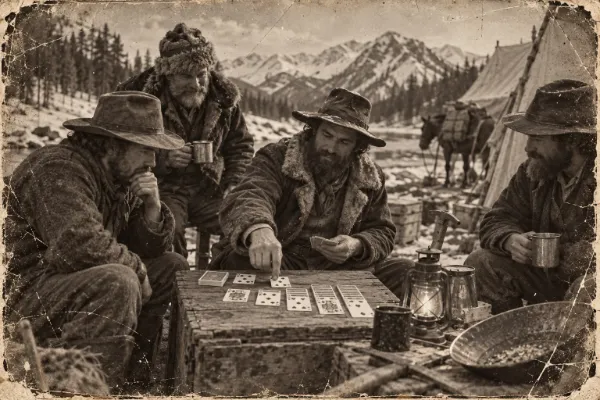
The version most people mean by “solitaire” is Klondike: seven columns, four foundations from Ace to King, and a stock of cards to draw from. (Our how to play solitaire page explains the full rules.) Its name points to the Klondike Gold Rush of 1896–1899, when tens of thousands of hopefuls headed for the Yukon in northern Canada and the word “Klondike” was everywhere.
The link is a good story, but it is not proven: no one has found firm evidence of where the name came from. What we do know is that the earliest printed rules for the game appear in the 1907 edition of Hoyle’s Games, under the name “Seven-Card Klondike”.
-
Klondike also picked up a second name that still causes confusion. In America it was sometimes called Canfield, perhaps because it was played as a gambling game at Richard Canfield’s casino in Saratoga Springs, New York, in the 1890s. The story goes that players bought a deck for $50 and won $5 back for every card they moved to the foundations. Early British books took up the name Canfield for Klondike, while in America the name Canfield later moved to a different game, the one the British call Demon. That is why the same name can mean two different games depending on where you are.
-

Through the 20th century, solitaire became the classic way to fill time alone. It needs no partner, no board and no special equipment, just one ordinary deck of 52 cards and a flat surface. That made it a natural companion anywhere people had long hours to pass and little else to do: on long journeys, in bunkhouses and barracks, in hospital wards and, famously, behind bars. The picture of someone alone with rows of cards became a familiar symbol of solitude itself.
-
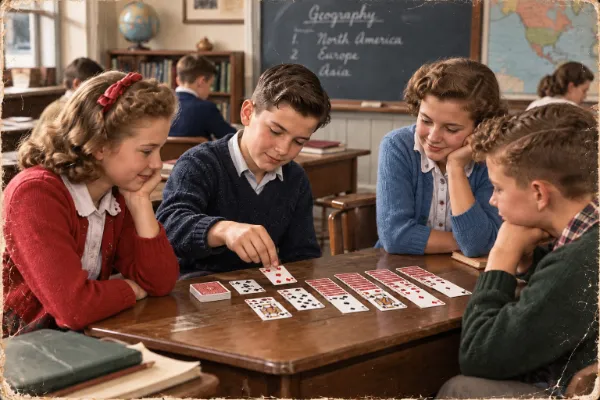
Solitaire was never only a lonely game, though. Families played it at the kitchen table, children learned it from grandparents, and friends would crowd round to point out a move the player had missed. Because the rules are simple but the choices are real, it has always worked as a gentle way to teach patience, planning and counting, and as a calm break in a busy day.
-
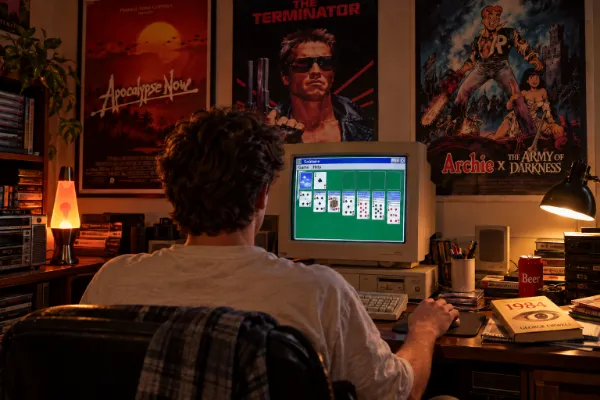
Home computers arrived in the 1980s, and solitaire followed them almost at once. A Klondike game for MS-DOS, played with a mouse, was released in 1984, and in 1987 Solitaire Royale brought a collection of eight solitaire games to the PC, Macintosh, Amiga and Apple IIGS. Computers took away the shuffling and dealing, and they never let you cheat by accident.
The biggest change in solitaire’s history came in 1990. On 22 May that year, Microsoft released Windows 3.0 with a free game called Solitaire: a version of Klondike written by an intern, Wes Cherry, in the summer of 1988, with a card deck designed by Susan Kare. Microsoft included it for a practical reason as well as for fun: many people had never used a mouse, and dragging cards from column to column was a painless way to learn how to click, drag and drop.
-
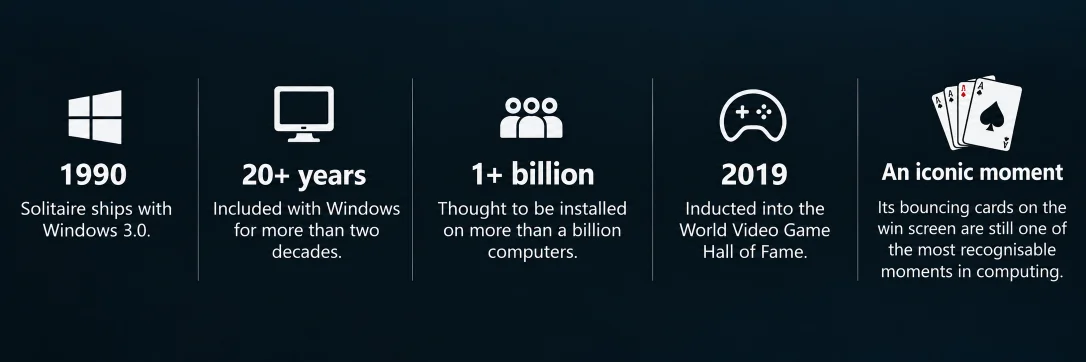
It worked better than anyone expected. Solitaire shipped with Windows for more than two decades (today its successor, the Microsoft Solitaire Collection, carries on the tradition), and it is thought to have been installed on more than a billion computers, making it one of the most widely played computer games ever. In 2019 it was inducted into the World Video Game Hall of Fame. Its bouncing cards on the win screen are still one of the most recognisable moments in computing.
-

Smartphones gave solitaire its next big boost. With a deck that fits in a pocket, a game now fits into a bus ride or a coffee queue, and a whole new generation of players has picked it up on a phone rather than at a table. Mobile solitaire grew sharply during the 2020 lockdowns, and app-market estimates reported by PocketGamer.biz show installs reaching a new high in 2025.
Timeline
- 1783: the earliest known description of patience appears in a German games book, as a game for two players taking turns.
- Early 1800s: patience becomes fashionable in France, then spreads to Britain and America.
- 1815–1821: Napoleon’s exile on St Helena; later legends claim he played patience there, but the evidence is thin.
- 1870s: Lady Adelaide Cadogan’s Illustrated Games of Patience helps make the pastime a Victorian favourite.
- 1896–1899: the Klondike Gold Rush; the game’s name is often linked to it, though the connection is unproven.
- 1907: the earliest printed rules for Klondike appear in Hoyle’s Games as “Seven-Card Klondike”.
- 1920s onwards: needing no partner and no special equipment, solitaire becomes the classic way to pass long hours alone, from barracks and hospital wards to prison cells.
- 1950s: generations learn solitaire at school desks and kitchen tables, with friends crowding round to spot a missed move.
- 1984: a mouse-driven Klondike game is released for MS-DOS home computers.
- 1987: Solitaire Royale collects eight solitaire games for the PC, Macintosh, Amiga and Apple IIGS.
- 1990: Microsoft Solitaire ships with Windows 3.0 and becomes one of the most played computer games ever.
- 2019: Microsoft Solitaire is inducted into the World Video Game Hall of Fame.
- 2020: mobile solitaire grows sharply during the pandemic lockdowns.
- 2025: mobile solitaire installs reach a new high, as a new generation plays on phones.
- Today: solitaire is played everywhere, from browsers and phones to the kitchen table.